If you’ve ever handed your toddler a tablet just to get through dinner — or noticed your teenager retreating to their room for hours on end, scrolling and silent — you’re not alone. Most of us feel it. Something is off. But connecting the dots between our kids’ screens and their emotional wellbeing can feel murky, even overwhelming.
In Episode 27 of the Screen Guardians Podcast, host Katie sits down with Tessa Stuckey — licensed family therapist, parenting coach, author of For the Sake of Our Youth, and founder of nonprofit Project Look Up — to talk about the social media effects on teen mental health that she’s witnessed firsthand in her therapy office since 2014. What she discovered changed everything.
Table of Contents
The Moment That Changed Everything
Tessa didn’t set out to become a digital wellness advocate. When she opened her private therapy practice, she was a new therapist in her 20s, a mom of four toddlers surviving on iPad games and Mickey Mouse. She was doing what most parents do.
But in her office, something unexpected was happening. Teenagers were coming in with serious mental health struggles — anxiety, depression, suicidal ideation, eating disorders — and none of the typical red flags were there. No trauma. No neglect. No substance abuse. Just seemingly typical kids from involved families.
Her supervisors kept telling her to look harder for the trauma. But Tessa kept listening. And the more she listened, the more one thread kept appearing: screens.
Then came the client she’ll never forget. A teenage girl looked her straight in the eye and said:
“Don’t you know? I grew up with this in my face, giving me anything I want exactly when I want it. I need relief immediately because I grew up with immediate relief from the screen.”
Tessa went home that night and didn’t sleep. She wrote in her journal until morning. And she told her husband: “I think we have to get rid of the iPads.”
What followed was extraordinary. She began asking every single client about their screen habits. She shifted her approach. And 100% of her clients — without medication, without hospitalization — started to feel better once they reduced screen time, improved sleep, increased physical activity, and reconnected in-person with people they loved.
“It was mind-boggling. I truly felt like I had discovered something.”
That discovery became a decade of advocacy, a nonprofit, a book, and a mission to make sure every parent has access to this information.
Social Media Effects on Teen Mental Health: What the Research — and the Therapy Room — Actually Show
The social media effects on teen mental health are not theoretical. They show up in real kids, in real therapy sessions, every single week. Here’s what Tessa says she sees most often:
Anxiety and Social Withdrawal
Social anxiety has become one of the most common presenting issues Tessa sees in teenage clients. And it doesn’t just look like shyness. It looks like a 15-year-old who can’t order their own food at a restaurant. A kid who won’t make a phone call. A teenager terrified of texting because they’re paralyzed by the fear of being left on read.
“They feel this pressure — if I text and they don’t respond, or if I don’t text back quick enough, they’ll get upset with me.”
Social media has created a constant performance loop. Even something as small as a text message has become a source of anxiety for today’s teens.
Depression, Loneliness, and Cyberbullying
Our society is lonelier than ever — and that loneliness is deeply connected to digital life. Tessa points to depression as a consistent pattern she sees in clients who are heavily immersed in social media, particularly when cyberbullying is involved.
And cyberbullying, she notes, is far more sophisticated than most parents realize. It’s not just name-calling. It’s being purposefully excluded from a hangout and then tagged in photos from that same event. It’s having your face drawn over in a group photo. It’s being cropped out so subtly you can barely prove it happened.
“Hurt people hurt people. And there are a lot of hurt people behind a screen who are now confident because they don’t have to see your reaction. They don’t have to deal with the remorse.”
Eating Disorders and Body Dysmorphia
Tessa references the book Careless People, written by a former Facebook employee, which reveals that Meta had an internal algorithm that would specifically feed body-image content to girls who deleted selfies. That’s not a bug. That’s a feature — one designed to exploit vulnerability in the least-developed brains.
“They are specifically looking for vulnerability in young minds who don’t have that risk assessment, that impulse control, or the ability to put the phone down easily.”
This is why eating disorders and body dysmorphia have skyrocketed among teen girls. The algorithm isn’t neutral. It’s engineered.
4 Warning Signs Every Parent Should Know
Tessa’s advice: don’t wait for a crisis. Watch for patterns. Specifically:
- A sudden, sustained shift in behavior — not a bad weekend, but weeks of withdrawal, isolation, or a personality change that isn’t lifting
- Lifestyle imbalance — neglecting hygiene, skipping meals, abandoning responsibilities, losing interest in things they used to love
- Sleep disruption — either they can’t sleep because of something they saw online, or they’re staying up until 2 AM scrolling
- Increasing emotional reactivity — especially when devices are taken away or limited
“A lot of times it comes back down to sleep. Sleep, eating, movement, in-person connection. When those things go, something is wrong.”
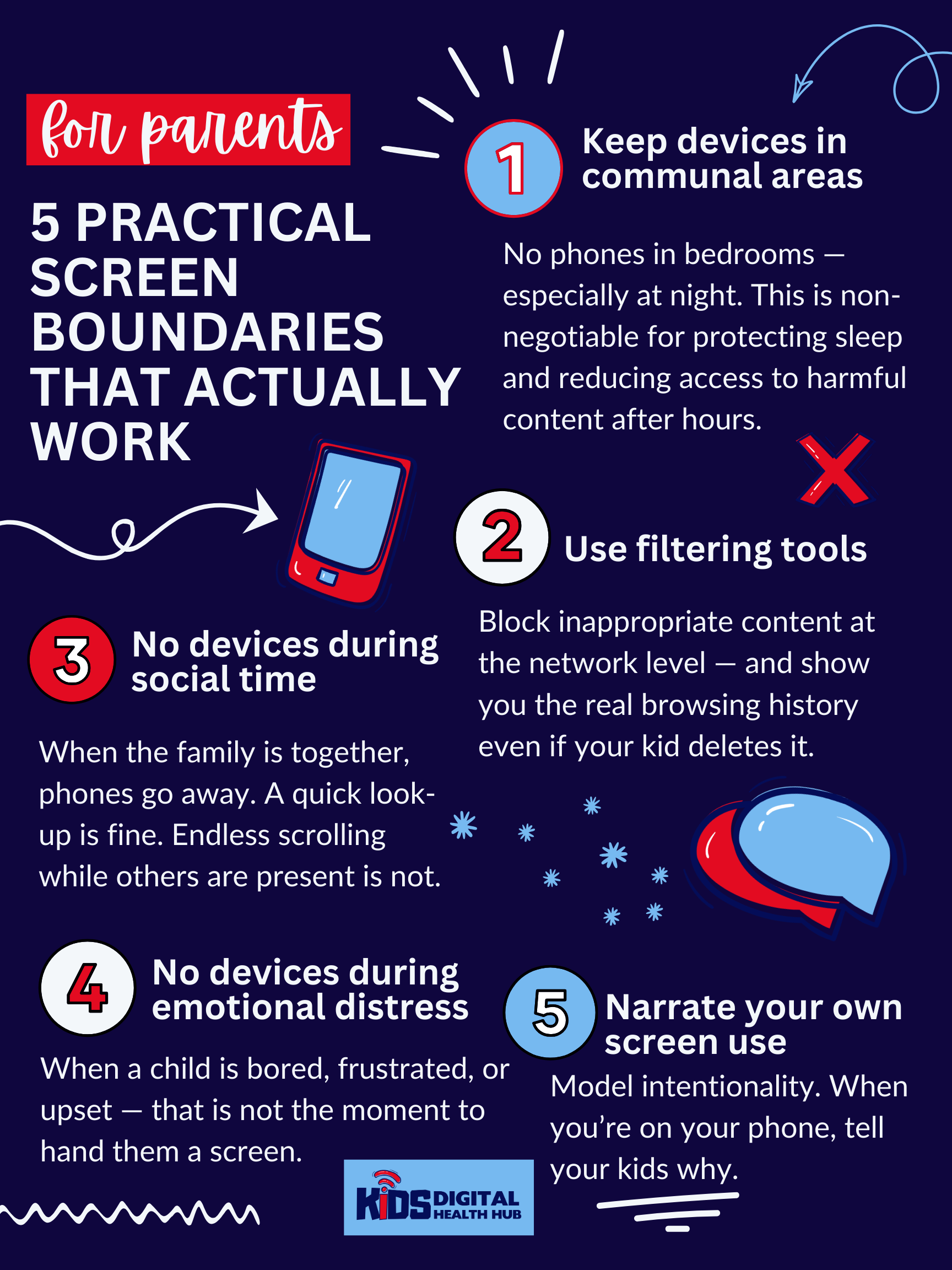
5 Practical Screen Boundaries That Actually Work
Here’s where Tessa gets practical. Setting screen boundaries doesn’t have to mean all-out war with your kids. But it does require consistency. Here’s what she recommends:
1. Keep devices in communal areas. No phones in bedrooms — especially at night. This is non-negotiable for protecting sleep and reducing access to harmful content after hours.
2. Use filtering tools. Tessa recommends tools like Bark Home or mesh routers like the Griffin router, which can block inappropriate content at the network level — and show you the real browsing history even if your kid deletes it.
3. No devices during social time. When the family is together, phones go away. A quick look-up is fine. Endless scrolling while others are present is not.
4. No devices during emotional distress. This is one of the most important rules Tessa shares with her clients. When a child is bored, frustrated, or upset — that is not the moment to hand them a screen. That is the moment to help them learn to sit with discomfort, feel their feelings, and develop real coping skills.
“We want our kids to struggle through boredom because if they can struggle through boredom, they can struggle through future life hardships. Because life has some hardships for all of us.”
5. Narrate your own screen use. Model intentionality. When you’re on your phone, tell your kids why: “I’m ordering groceries.” “I’m emailing your teacher.” “I need to check the weather before we leave.” This teaches them that screen use has a purpose — and that endless entertainment is a choice, not a default.
How to Course Correct If You’ve Already Given Too Much
One of the most common questions Tessa hears from parents: “We already let things go too far. How do we walk it back without blowing up our family?”
Her answer is nuanced and practical:
Don’t wait for the storm to have the conversation. Pick a calm, connected moment when everyone’s in a good headspace. Trying to establish new rules in the middle of a conflict almost never works.
Take ownership as the parent. Don’t make it about one child’s bad behavior. Tessa coaches parents to say something like: “We gave you this device too soon. We allowed too much time. This is not a punishment. We’re making a change together — as a family.”
Make it a team effort. Set new boundaries that include everyone — including the parents. When kids see that mom and dad are also scaling back, the resistance often softens.
Speak their language. If your teen responds to visuals, watch a documentary together — she recommends Childhood 2.0. If they’re readers, try Glow Kids or The Anxious Generation. If they need to hear something scary to take it seriously, find a news segment together. Meet them where they are.
“You have to figure out how they might hear it best. And then know it’s going to be uncomfortable for you too — because they are going to push back. But you have resilience and strength. And you have to model that resilience for them.”
The Brain Science Behind Why This Is So Hard
Let’s talk about what’s actually happening neurologically — because understanding the science takes the shame out of the struggle.
The prefrontal cortex — the part of the brain responsible for impulse control, risk assessment, long-term thinking, and decision-making — is not fully developed until age 25 to 28. That means every teenager is, quite literally, making decisions without a fully functional brake system.
Social media is designed to exploit exactly that gap. Dopamine — the reward chemical — releases every time a notification comes in, every time a video autoplays, every time someone likes a post. The brain learns to crave that hit. And without the prefrontal cortex fully online to say “enough,” the scroll just… continues.
“Logic goes out the window. Impulse runs the show.”
Tessa’s reframe for parents: stop thinking of yourself as the punisher. Start thinking of yourself as the manager.
“You are the manager of your family. You are the manager of your kids. And as they grow, they start being promoted to more manager positions — but they’re not quite there yet.”
Your job isn’t to control them forever. Your job is to act as their prefrontal cortex until theirs catches up — and to coach them toward managing themselves before they leave your house.
One Simple Change to Make This Week
Tessa’s single piece of advice for families this week:
Observe. Before you change anything, just watch. Is the screen time in your home productive — for work, schoolwork, creativity, learning? Or is it primarily entertainment — scrolling for boredom, background noise, emotional numbing?
Productive screen time has a purpose. Entertainment-only screen time, especially when used to avoid discomfort, is what builds the dependency patterns that lead to the mental health struggles she sees in her clients.
Once you can see the pattern clearly, you’ll know exactly what to work on.
You Don’t Have to Figure This Out Alone
Parenting in the digital age is hard. The technology moves fast. The pushback from kids is real. And it’s easy to feel like you’re the only parent still holding the line.
You’re not. Not even close.
Tessa Stuckey has been doing this work since 2015 — and she still has days where her own kids ask her for Nintendo seventeen times in a row. The work is ongoing. The journey is imperfect. And the goal isn’t perfect kids — it’s kids who are building the resilience, the self-worth, and the self-confidence to become the amazing adults they’re meant to be.
“This hardship as a parent — it’s only temporary. We only have to get through it for a temporary amount of time. And as humans, we can do anything as long as it’s temporary.”
If you’re looking for support on this journey, join our free parent newsletter or explore the KDHH Parent Portal — a calm, resource-rich space with practical tools, conversation starters, and scripts for the hard conversations. You don’t have to navigate this alone.
You can also connect with Tessa Stuckey at tessastuckey.com and projectlkup.org, and find her on Instagram and Facebook as @themomtherapist.
And to hear the full conversation, listen to Episode 27 of the Screen Guardians Podcast.
Frequently Asked Questions
What are the most common social media effects on teen mental health?
According to family therapist Tessa Stuckey, the most common effects include social anxiety, depression, eating disorders, body dysmorphia, and loneliness. Many of these are connected to how social media algorithms are specifically designed to exploit vulnerability in developing brains — feeding body-image content to insecure teens, rewarding engagement through dopamine loops, and enabling cyberbullying in sophisticated and hard-to-detect ways.
At what age should kids get access to social media?
There’s no universal answer, but Tessa’s personal and professional experience supports waiting as long as possible. Her own children — ages 14, 12, and twins — do not have social media, and she reports they communicate well with friends, fill their boredom creatively, and frequently thank her for the boundaries. The research increasingly supports delaying access until at least age 16, and many experts recommend waiting until the prefrontal cortex is more developed.
How do I know if my teenager’s social media use is hurting their mental health?
Watch for sustained changes in behavior — not a bad weekend, but weeks of withdrawal, sleep disruption, lifestyle imbalance, or emotional dysregulation. Tessa recommends looking at the overall balance of your child’s life: are they sleeping, eating, connecting in-person, and meeting their responsibilities? If those basics are breaking down, screen habits are often a contributing factor worth examining.
How can I set screen boundaries without constant conflict?
Tessa’s top advice is to have the conversation during calm moments, not in the middle of a conflict. Take ownership as the parent — frame changes as a family reset, not a punishment. Set boundaries that apply to everyone in the household, including parents. And be consistent: one well-held boundary does more than ten rules that bend under pressure.
What’s the best first step if I feel like screen time has gotten out of control?
Start by observing, not reacting. Watch whether your family’s screen time is primarily productive (work, learning, creativity) or entertainment-driven (scrolling, boredom, emotional numbing). Once you can see the pattern clearly, you’ll have a much better sense of what needs to change — and where to start. Resources like KDHH’s free parent course can also help you take next steps without feeling overwhelmed.