
Screen-based learning vs traditional learning has become one of the most important conversations in modern education. As classrooms increasingly rely on iPads and Chromebooks, many parents and educators are asking an urgent question:
Are kids learning better from iPads—or from books?
At Kids Digital Health Hub (KDHH) and through The Screen Guardians program, we examine this question through a child-development, brain-health, and classroom-impact lens. We are not anti-technology. We are pro-child. And how children learn matters as much as what they learn.
Table of Contents
What Is Screen-Based Learning?
Screen-based learning refers to instruction delivered primarily through digital devices such as:
- iPads
- Chromebooks
- Tablets and laptops
- Digital curricula and learning platforms
In many classrooms today, students read, write, test, research, and submit work almost entirely on screens. While this approach offers efficiency and access, it also fundamentally changes how the developing brain processes information.
What Is Traditional Learning?
Traditional learning includes:
- Reading physical books
- Writing by hand
- Teacher-led instruction and discussion
- Paper-based assignments
- Movement, routine, and face-to-face interaction
This approach engages multiple sensory systems at once—visual, tactile, auditory, and motor—supporting attention, memory, and deeper understanding.

Kids Learning From iPads vs Books: What Happens in the Brain?
When we compare kids learning from iPads vs books, the difference is neurological—not just personal preference.
Learning From Books
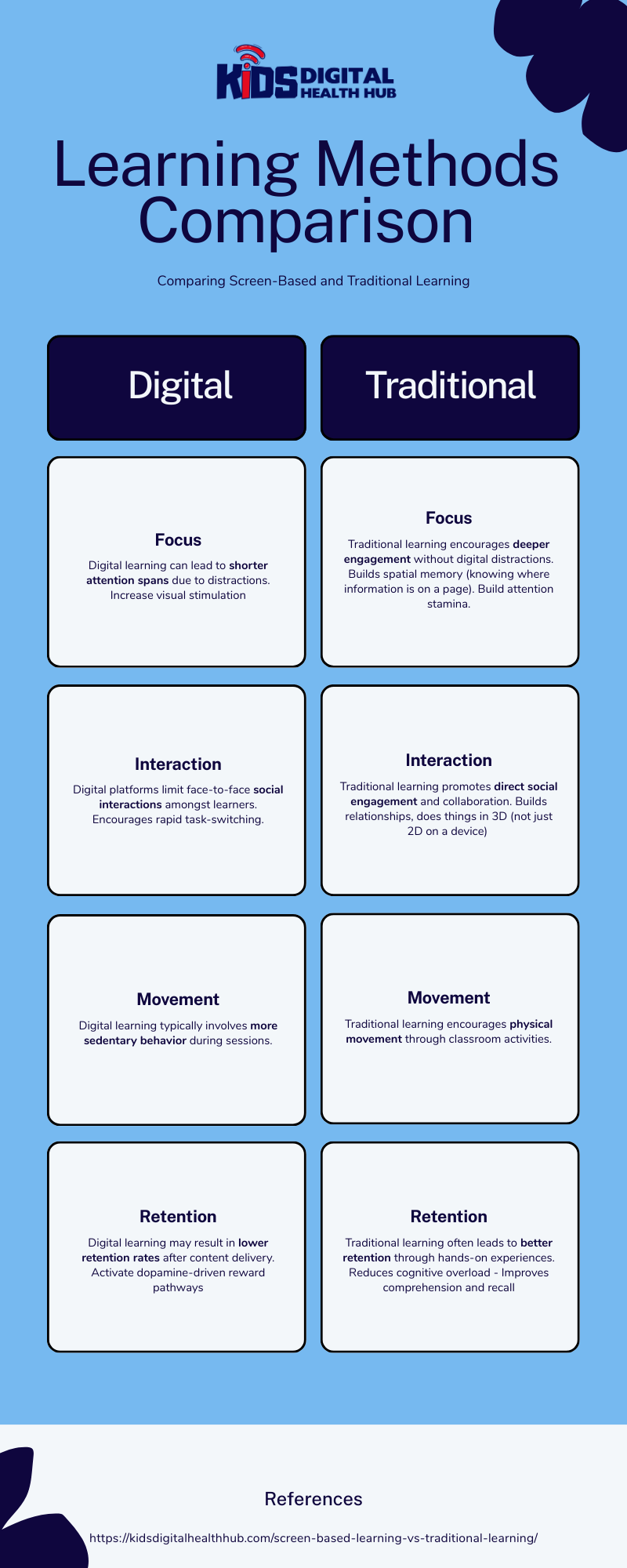
Research shows that reading from physical books:
- Improves comprehension and recall
- Strengthens sustained attention
- Builds spatial memory (knowing where information is on a page)
- Reduces cognitive overload
Children are more likely to slow down, reflect, and process information deeply when reading from paper.
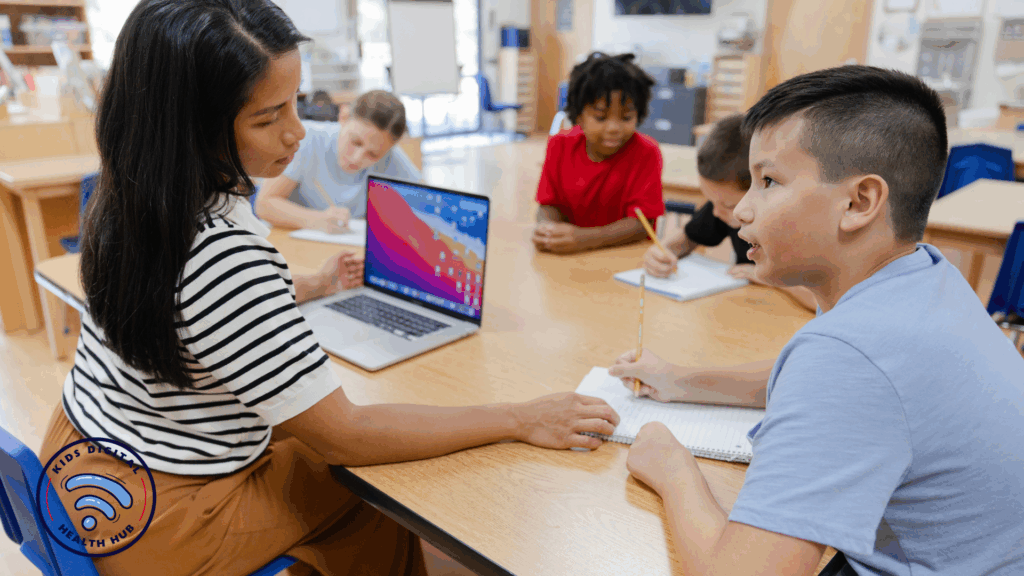
Learning From iPads
Screen-based reading and writing:
- Increase visual stimulation
- Encourage scanning and scrolling rather than deep reading
- Introduce built-in distractions
- Activate dopamine-driven reward pathways
Screens are optimized for speed and engagement—not depth. Over time, this can make slower, effort-based learning feel frustrating or boring for developing brains.
The Dopamine Difference in Screen-Based Learning
A critical factor in the screen-based learning vs traditional learning discussion is dopamine—the brain’s motivation and reward chemical.
Screen-based learning environments often:
- Provide constant novelty
- Offer immediate feedback
- Encourage rapid task-switching
This conditions the brain to expect stimulation, making focus, patience, and persistence harder to develop.
Traditional learning, by contrast, helps children:
- Tolerate frustration
- Build attention stamina
- Strengthens executive function and self-regulation
- Builds relationships, does things in 3D (not just 2D on a device)
- Helps develop communication skills, patience, empathy and social and emotional skills not used or accessed when using a device.
Susan Dunaway’s Perspective: What Screens Can’t Teach
Long before one-to-one device programs became common, neurotherapist Susan Dunaway raised concerns about screen-heavy learning environments and their impact on child development.
In the Screen Guardians Podcast episode, “What screens can’t teach: A conversation about the growing cost of digital learning”, Dunaway explains that screens cannot replace:
- Body-based learning
- Sensory input
- Handwriting and fine motor development
- Emotional regulation built through human interaction
She emphasizes that children learn best when the brain and body work together—and that excessive screen-based instruction can disrupt the sensory and neurological foundations required for learning.
This conversation reinforces a core Screen Guardians principle:
Technology should support learning—not replace the developmental experiences children need to grow.
What Research Says About Screen-Based Learning vs Traditional Learning
Current research aligns closely with Dunaway’s insights:
- Students consistently comprehend and retain more when reading from paper than screens
- Handwriting improves memory, idea generation, and understanding compared to typing
- Excessive screen use is linked to increased distraction and reduced deep learning
While technology can be a useful educational tool, research supports intentional limits and balance, especially in elementary and middle school years.
How Screen Guardians Approaches Learning and Technology
Kids Digital Health Hub and the Screen Guardians program take a developmentally informed, research-based approach.
We teach students, parents, and educators:
- How the brain learns
- Why movement, handwriting, and discussion matter
- How screens affect attention, emotions, and behavior
- When technology is helpful—and when it interferes with learning
We are not advocating for eliminating technology. We are advocating for guardrails that protect focus, learning, and healthy brain development.
So, What’s Better for Kids—iPads or Books?
When asking whether kids learning from iPads vs books is better, the answer is clear:
Books and traditional learning should be the foundation.
Screens should be:
- Purposeful
- Limited
- Developmentally appropriate
- Used as tools—not replacements
When screens dominate learning environments, children lose opportunities to build the focus and resilience needed for lifelong learning.
Rethinking Learning in a Digital World
The debate over screen-based learning vs traditional learning isn’t about resisting progress—it’s about protecting childhood.
Children’s brains are still developing. The way they learn today shapes how they think, focus, and regulate emotions tomorrow.
At Screen Guardians and Kids Digital Health Hub, we believe:
Protecting childhood is protecting learning.
And some of the most important lessons…
are the ones screens can’t teach.