
I always thought I had a pretty good handle on the digital world my kids lived in. I teach this stuff. I write school programs on this stuff. I preach about digital health, the role of dopamine and screen habits.
But nothing will give you a reality check faster than observing and causally glancing through a middle-school group chat. Group chat dangers for kids? Yes it exists.
Recently, I had the… let’s call it eye-opening… experience of getting a front-row seat to the way a group of 12–13-year-olds communicate. And let me tell you: it taught me more in one night than some adults learn in years.
What I saw confirmed something I’ve been circling around for a while:
My 7th grader absolutely does not need her own phone. Needless to say an iPhone with camera/video capabilities, social media apps and the internet in their pocket at all times…. Not happening anytime soon.
Here’s why.
Table of Contents
Why I’m delaying the smartphone: 6 lessons from one night inside my teen’s group chat
1. Impulse Control + Peer Influence = A Dangerous Combo
Middle-schoolers are wired for emotion, excitement, and belonging — NOT logic. When one kid gets silly or dramatic, others follow immediately.
That’s not a moral failing. It’s neurodevelopment.
The prefrontal cortex (the part that manages reasoning and impulse control-we call it the thinking brain) is still under construction. The limbic system (the part that loves thrill, connection, and approval-what we call the emotional brain) is fully awake.
In a group chat, logic goes out the window.
Impulse runs the show.
Peers become the compass.
And it happens fast!!!
2. Time Limits and Access Windows Are Non-Negotiable
I saw how easy it is for a 7th grader to go from asking a question “for homework” to being consumed or you could even say, lost in a 100+ message conversation (unrelated to homework) in just a matter of minutes.
Without guardrails, notifications pull them in constantly — each ping a tiny hit of:
Dopamine. Dopamine. Dopamine.
It’s the reward chemical that says:
- Check the message!
- You might be missing out!
- Someone might be talking about you!
- Something fun might be happening!
Kids are not built to resist that. Honestly, most adults aren’t either.
So in my mind these 3 things are pivotal:
– Notification settings matter! (preserve your peace and the rest of the house)
– Phone free zones
– Time limits. (set tie frames for phone use and stick to it)
3. Misunderstandings Happen Constantly
In text messages, (which includes memes, gifs, emojis, etc)
Tone is absent.
Context is missing.
Intent gets twisted.
Kids read messages through an emotional brain, not a rational one.
A quick “fine.” can feel like anger.
A joke can land like an insult.
Sarcasm becomes cruelty.
A comment meant for one person can feel like a blast announcement.
And the emotional fallout is real: anxiety, FOMO, insecurity, and stress.
4. Group Chats Become Breeding Grounds for Bullying and “Jokes” Gone Wrong
When kids get excited, the chat escalates. When someone feels embarrassed, they push back harder. When a joke gets attention, it gets repeated.
What I saw:
- harmless jokes turning mean
- oversharing
- kids piling on
- subtle exclusion
- moments of real hurt dressed up as “just kidding”
None of it was from bad kids. It was from immature brains handed powerful tools and likely not enough guardrails. ‘
5. Photos & Videos Require Strong, Clear, Non-Negotiable Rules
Middle school is messy enough without adding the ability to:
- screenshot
- record
- share
- save
- forward
- send to “just one person” (which never stays with one person)
Kids don’t understand permanence.
They don’t understand digital footprint.
They don’t understand legal and safety boundaries.
They truly can’t.
So we must.
There must be rules for:
- If they’re allowed to take videos/photos at all
- Where they can take photos/videos in the house (this includes FaceTime)
- What they wear when recording
- Always getting permission before recording or taking a screen shot of someone
- Always getting permission before sending or sharing anything
- Never sharing someone else’s image, face, or voice without consent
This isn’t about being strict — it’s about keeping them safe.
6. Kids Don’t Know the Risks
(And They Can’t Understand the Consequences Yet)
My daughter didn’t like the boundaries I set after reviewing one of her group chats.
But she doesn’t have to.
Because kids:
- don’t see the risks
- can’t anticipate the fallout
- don’t understand the legal implications
- can’t self-regulate dopamine-driven behavior
- don’t yet have the cognitive capacity to pause before acting
Parental guidance isn’t controlling — it’s essential.
There is so much opportunity to teach, coach, redirect, and guide. Parenting in a digital world is actually significantly harder than I ever thought. The battles we face are not the same battles we had with our parents and the risks are very different. But I know my job is being her mom. Keeping her safe sometimes makes me the bad guy-I’ve accepted that. It’s hard and I’ve cried a few tears over it, but it’s a role I’m not willing to compromise for convenience.
“Parental guidance in the digital world isn’t about control. It’s about protection. It’s about presence. It’s about love that’s willing to be misunderstood.”
parents need to know: What I Learned from Reviewing the Group Chat
- My daughter doesn’t need her own phone yet.
- A smartphone with cameras/videos is absolutely not necessary.
- Dopamine is a major driver in group text behavior.
- Impulse control disappears in group dynamics.
- Peer influence is incredibly strong at this age.
- Notifications keep kids in a constant state of distraction and FOMO.
- Messages are easily misunderstood without tone or context.
- Group chats can quickly become unintentionally hurtful.
- Oversharing happens instantly.
- Pictures and videos are risky without strict rules.
- Middle schoolers cannot comprehend long-term consequences.
- Strong parental guidance isn’t optional — it’s protective.
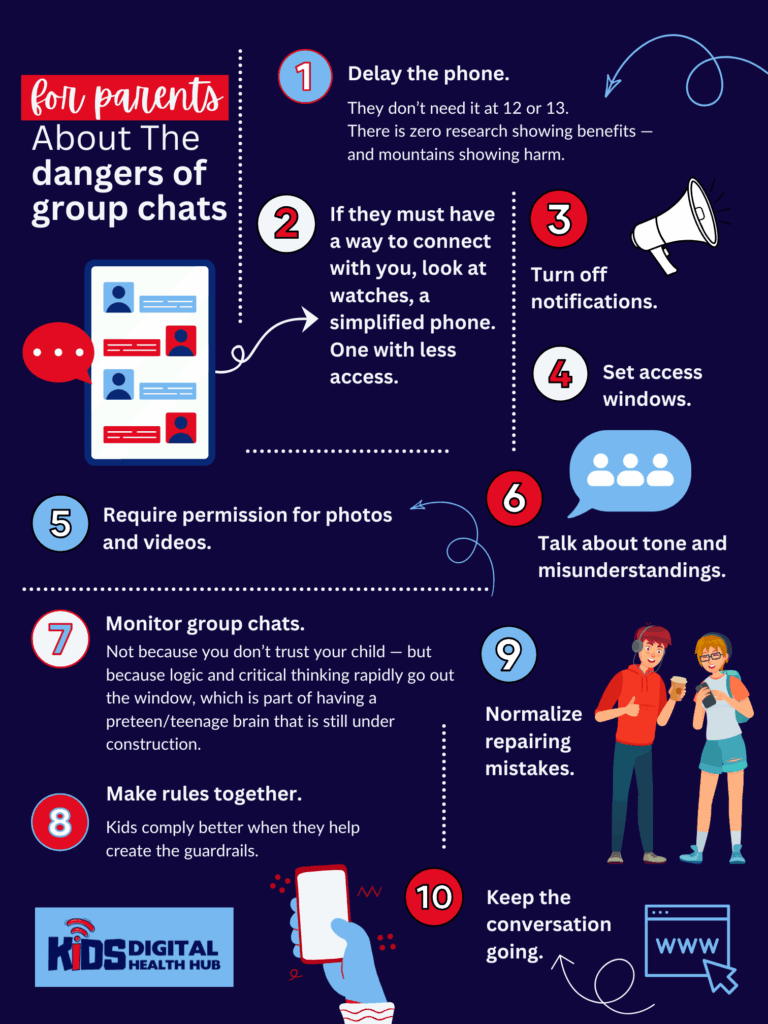
What I Recommend to Parents About The dangers of group chats
1. Delay the phone. Seriously.
They don’t need it at 12 or 13.
There is zero research showing benefits — and mountains showing harm.
2. If they must have a way to connect with you, look at watches, a simplified phone. One with less access.
Consider:
- Gabb
- Pinwheel
- Bark Phone
- Wisephone
- Basic flip phone!
No internet.
No App Store.
No cameras/video.
No group chats.
Or you can try what we do, which is hand over your phone for a small amount of time. I’m actually so grateful because it’s more “contained.” This allows her to use my iphone or ipad with my permission, guidance and she knows I WILL see everything.
3. Turn off notifications.
I often have the ringer turned off, all notifications silenced and this is especially necessary for her for the :
- group chats
- social messaging apps (if your child has them, and in our house our kids do not)
- anything with a constant “ping” or even the vibration sound
Your child deserves deep focus, not dopamine traps.
4. Set access windows.
For example:
- phone available 4–7 PM
- then docked in a common space
This prevents late-night stress and endless scrolling.
5. Require permission for photos and videos.
And set boundaries about:
- if photos/videos can be taken
- where photos can be taken
- what’s appropriate
- what can be shared
- what it means to obtain consent every single time
6. Talk about tone and misunderstandings.
Teach kids how easily texts can be misread.
7. Monitor group chats.
Not because you don’t trust your child — but because logic and critical thinking rapidly go out the window, which is part of having a preteen/teenage brain that is still under construction.
8. Make rules together.
Kids comply better when they help create the guardrails.
9. Normalize repairing mistakes.
Teach your child how to:
- apologize
- take accountability
- repair harm
- reset and move forward
In our program we have a tool called the Recovery Plan that helps kids and parents plan and prepare for this digital mistakes. If interested in learning more about this you can find it in our Parent Portal.
10. Keep the conversation going.
Kids need ongoing coaching — not a one-time talk.
The Bottom Line About Group chat dangers for kids
Kids cannot handle the complexity, speed, and dopamine pull of modern group chats — not because they’re irresponsible, but because their brains are still growing.
Screens aren’t evil. Tech isn’t the enemy.
But unrestricted access is.
“Screens aren’t evil. Tech isn’t the enemy. But unrestricted access for immature brains? That’s a risk we can’t ignore.”
Middle schoolers need:
- time limits
- guidance
- rules
- support
- oversight
- a parent willing to be the “mean one” sometimes
Because they genuinely cannot see the risks that we can.
And the truth is — they don’t need a smartphone to be safe, social, connected, or happy.
They need us.