
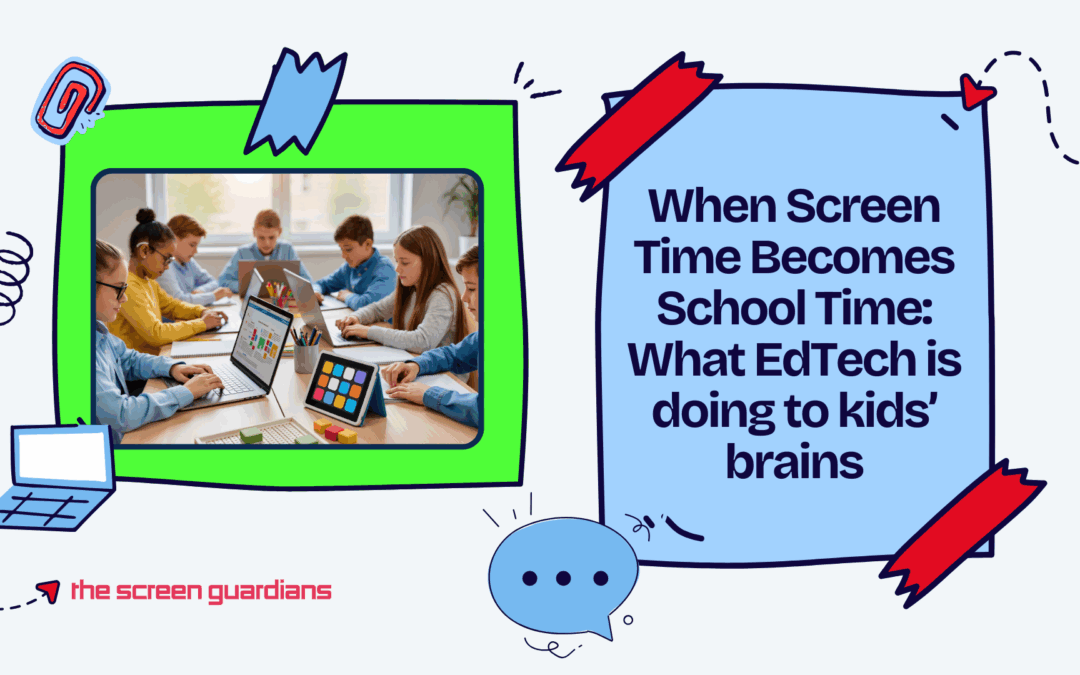
Screen time in schools has become the new normal—woven into nearly every subject, every lesson, every day. From Chromebooks and tablets to gamified apps and video-based instruction, educational technology now occupies a central space in our classrooms. And while these tools promised engagement and innovation, many educators and parents are asking a harder, more human question: What is all this screen time actually doing to our children’s ability to learn, focus, and thrive? At Screen Guardians, we don’t come with fear or fast fixes—we come with science, lived experience, and a deep desire to restore balance. Because children deserve more than just access to technology. They deserve an education that puts their brains, their bodies, and their well-being first.
Table of Contents
Is It Time to Reevaluate EdTech? What the Research Says About Screens, Learning, and the Modern Classroom
Educational technology—known as EdTech—has become a centerpiece of modern schooling. Devices sit on every desk. Learning platforms are logged into every day. Entire subjects now live online. But as test scores decline, attention challenges rise, and emotional regulation becomes more difficult for students, one question is becoming impossible to avoid:
Do we need to rethink how much—and how—children use screens in school?
The answer, grounded in neuroscience and echoed by a decade of warnings from experts like neurotherapist Susan Dunaway, is a clear yes.
But the solution isn’t to fear technology.
It’s to teach students how their brains work, set strong guardrails, and rebuild the parts of learning that can’t happen on a device.
This is exactly why Screen Guardians exists.
What Is EdTech and Why Did It Take Over Classrooms?
EdTech—short for educational technology—is any digital tool, platform, or device used to support or deliver learning. It’s the intersection of education and technology, and while it promises innovation, it also brings important questions to the surface—especially for those of us who work closely with children.
EdTech includes:
- Chromebooks, tablets, laptops
- Online curricula and adaptive learning apps (like Khan Academy or Google Classroom)
- Video-based lessons and gamified programs
- Learning management systems and digital assessments

After the COVID-19 pandemic, EdTech became more than a support—it became the backbone of instruction in many schools. Devices became standard. Paper became optional. Human connection, in some places, became a secondary feature.
The COVID-19 pandemic accelerated its dominance. Schools scrambled to deliver instruction online, and ever since, digital use in classrooms has only grown. By 2022, EdTech wasn’t an enhancement—it became expected.
And while technology can be a powerful tool, it’s not neutral. How we use it—and how much we rely on it—shapes more than academic outcomes. It shapes attention, motivation, emotional health, and brain development.
So when we talk about EdTech, we’re not just talking about flashy tools or efficient delivery systems.
We’re talking about the way children experience learning—moment by moment, day by day—and whether that experience is helping them thrive, or making it harder for their minds (and bodies) to stay balanced.
At Screen Guardians, we don’t oppose technology.
We simply believe it should serve a child’s development, not disrupt it.
The Problem: More Tech Hasn’t Made Learning Better
National and international assessments paint a consistent picture:
- NAEP shows the largest decline in reading in 30 years.
- Math scores have fallen for the first time in history.
- Students struggle more with attention, memory, and comprehension.
While the pandemic played a role, the neuroscience is clear:
excessive digital learning is reshaping the developing brain.
This is what Susan Dunaway started warning schools about nearly a decade ago.
Susan Dunaway’s Early Warning That Few Wanted to Hear
Long before students had 1:1 devices, Dunaway—then working with neurofeedback, brain mapping, and child/adolescent mental health—noticed disturbing trends:
- shorter attention spans
- increased emotional reactivity
- dependence on fast-paced stimulation
- difficulty persisting with slow, effortful work
- weakened executive-function skills
Her message was consistent and research-aligned:
“You cannot build a healthy, resilient brain on rapid-fire digital input. Children need slow, steady, real-life learning experiences to wire their brains for focus, patience, and self-control.”
A decade later, the data has caught up to her predictions.

3 Reasons Why EdTech Works Against How the Brain Learns
1. Digital learning activates dopamine, not deep learning pathways.
Most learning apps rely on:
- instant rewards
- animations
- bright colors
- rapid progression
These features stimulate dopamine—the brain’s reward system—rather than the neural networks used for comprehension, memory, and critical thinking.
This turns students into “dopamine chasers” who crave stimulation and resist real academic effort.
This is why Screen Guardians intentionally teaches:
- What dopamine is
- How screens can hijack it
- How to build stronger focus pathways instead
Students learn how their brains work so they understand why boundaries matter.
2. Screens overwhelm attention networks.
Research shows high screen use reduces the brain’s ability to:
- sustain focus
- organize thoughts
- plan ahead
- manage distractions
This is especially problematic for children, whose prefrontal cortex is still under construction through their mid-20s.
This aligns with Dunaway’s neurofeedback findings from nearly 10 years ago—and why Screen Guardians teaches children:
- how the thinking brain and feeling brain respond differently to screens
- how to protect attention pathways
how to shift from “jumpy brain” to “focus brain” activities
3. Classroom learning activates sensory and social systems digital tools can’t.
Devices cannot replace:
- eye contact
- real conversation
- handwriting
- problem-solving with peers
- hands-on movement
- kinesthetic learning
These multisensory experiences strengthen neural pathways in ways screens simply do not.
Screen Guardians is intentionally designed to be taught in classrooms, not on devices, so students build the developmental skills EdTech often bypasses:
- patience
- self-regulation
- working memory
- empathy
- real-world communication
We are not anti-technology—we are pro-brain development.
Why Screen Guardians Teaches Children How Their Brain Works
One of the most unique and powerful components of Screen Guardians is its brain-based approach.
Students learn:
- how dopamine affects motivation
- why their brains crave novelty
- how attention pathways grow or weaken
- how movement, sleep, and stress shape learning
- how the thinking brain and feeling brain react differently to screens
- why boundaries help—not hurt—their independence
When students understand the science, they make healthier choices on their own.
This is the opposite of fear-based teaching—it is empowerment.
Healthy Boundaries, Not Restrictions
Screen Guardians doesn’t tell kids:
❌ “Screens are bad.”
❌ “Technology is dangerous.”
Instead, it teaches:
✅ “Your brain is powerful and still developing.”
✅ “Tech is a tool, but your brain should stay in charge.”
✅ “Healthy guardrails keep your thinking brain strong.”
✅ “You can use tech without letting it use you.”
The key isn’t avoiding technology, but teaching skills and ways to enhance digital wisdom, awareness, and agency.
The Bottom Line on EdTech and brain development: Tech Isn’t the Problem. Unbalanced Tech Is.
EdTech can be incredible when used intentionally.
But real learning still depends on:
- human connection
- movement
- hands-on exploration
- slow thinking
- internal motivation
These are the foundations The Screen Guardians Program has built to restore.
We believe:
- in classrooms full of curiosity, not distraction
- in brains built for learning, not dopamine chasing
- in technology that empowers—not overrides—development
- in parents and teachers equipped with real, science-based tools
And most importantly, we believe children deserve both a digital world and a healthy brain to navigate it.